close
Choose Your Site
Global
Social Media

Views: 0 Author: Site Editor Publish Time: 2026-09-30 Origin: Site
Scaling flat rice noodle production introduces complex engineering challenges. Minor fluctuations in moisture, temperature, or ingredient formulation easily compromise noodle elasticity and uniform thickness. Manufacturers face intense pressure to transition from labor-intensive, semi-manual processes to high-capacity continuous lines. These modern setups often target highly stable commercial daily outputs of 900–1200 kg/hr. Achieving this scale without sacrificing product quality, increasing edge waste, or violating strict food safety standards requires precise mechanical control. Evaluating modern equipment means looking far beyond top-line output numbers. This guide breaks down the critical components, automation levels, formulation handling, and implementation realities necessary to select a system that delivers reliable, profitable yield.
True efficiency in flat rice noodle manufacturing relies on continuous processing that minimizes manual product handling between the milling, steaming, and drying stages.
Component synchronization—specifically matching the output of the Rice Grinder to the cooking route and the capacity of the Commercial Food Dryer—is critical to preventing production bottlenecks and inconsistent moisture levels.
Sanitary, 100% food-grade design with Clean-in-Place (CIP) capabilities is non-negotiable for regulatory compliance and minimizing cleaning-related downtime.
Transitioning to a fully automated system requires a rigorous assessment of facility footprint, utility infrastructure (steam and electrical), and the integration of inline quality checks at every stage of production.
Operating a production line at maximum mechanical speed often introduces severe trade-offs in product quality. Pushing a conveyor belt beyond its designed thermal capacity prevents complete starch gelatinization inside the steaming tunnel. When amylose and amylopectin molecules do not absorb enough thermal energy, they fail to swell and burst properly. This incomplete gelatinization results in a raw core, producing brittle noodles that lack the uniform thickness and elasticity required by consumers. Engineering teams must balance belt speed with the required dwell time in the cooking route to ensure the thermal mass of the batter reaches the exact target temperature.
Establishing baseline capacity requirements involves understanding the structural differences between equipment tiers. An entry-level commercial line processing 500 kg/hr typically utilizes narrower belts and shorter steaming zones, requiring closer operator monitoring to adjust steam valves manually. In contrast, a 1200 kg/hr industrial line relies on wider continuous belts—often spanning 1000mm to 1200mm—multi-zone thermal controls, and heavy-duty variable frequency drive (VFD) motors to maintain highly stable daily output. The industrial setup absorbs minor upstream feed variations without translating those defects into the final noodle sheet, allowing the facility to scale output without degrading texture.
Raw material waste directly erodes batch profitability. During the slitting and cutting phases, continuous sheets are trimmed to exact widths. Poorly calibrated rotary cutters or misaligned conveyor tracking generate excessive edge trim. If a 1000mm sheet drifts by just 5mm, the line loses a measurable percentage of yield instantly. High-efficiency Flat Rice Noodles Production Lines integrate active edge-return systems to combat this loss. These mechanisms capture trim waste immediately after the slitter, macerate it, and route it back into the initial batter mixing stage. By blending rework at a strictly controlled ratio (typically under 10%), manufacturers recover raw material without altering the rheological properties of the virgin batter.
Moisture retention metrics serve as another primary yield indicator. Noodle manufacturers are effectively selling water weight alongside starch. Over-drying noodles by even 1% or 2% below the target specification causes massive weight loss across a production shift. Over a standard 10-ton run, a 2% moisture deficit equates to 200kg of lost saleable product. Furthermore, excessive moisture loss compromises texture, leading to surface cracking and structural failure during packaging. Precision airflow controls and exhaust dampers ensure the final product retains exact moisture targets, maximizing both structural integrity and total revenue.
Manual batch transfers introduce high risks of product contamination and physical damage to delicate noodle sheets. Relying on operators to push heavy racks of hot trays between steaming, cooling, and drying rooms causes uneven cooling rates and exposes the product to airborne pathogens. Shifting to continuous automated conveying eliminates these manual touchpoints. Using modular plastic belting or Teflon-coated fiberglass conveyors, the product flows seamlessly from one thermal zone to the next. This continuous flow drastically reduces direct labor costs—often dropping shift requirements from twelve operators down to three—and standardizes the handling process.
Managing these automated sequences requires robust control systems. Modern lines utilize Programmable Logic Controller (PLC) interfaces paired with Human Machine Interface (HMI) touchscreens. Operators manage recipe parameters, belt speeds, and temperature zones from a centralized station. Advanced PLC systems log historical data, monitor motor loads, and trigger alarms for steam pressure drops. This immediate feedback loop allows line operators to execute rapid troubleshooting, preventing minor mechanical faults from escalating into full line stoppages.
Consistent batter formulation dictates the final texture of the noodle. Automated dosing systems continuously measure and inject exact ratios of water, salt, and texture-enhancing starches into the mixing tanks using mass flow meters. Precision formulation boosts elasticity, improves mouthfeel, and extends the shelf-life of the packaged product. Manual measuring introduces human error, leading to batch-to-batch inconsistencies that automated dosing entirely eliminates.
The milling process itself determines the viscosity and smoothness of the batter. Wet milling remains the preferred approach for flat noodle formulation. Facilities soak the raw rice for four to six hours to soften the endosperm before processing. Integrating a high-performance Rice Grinder ensures exact particle size consistency. If the grinder allows oversized particles to pass, the resulting batter will contain grit. This grit creates structural defects and weak points in the final noodle sheet, leading to breakage during the slitting phase.
Milling Method | Process Description | Particle Consistency | Impact on Noodle Texture |
|---|---|---|---|
Wet Milling | Rice is soaked for 4-6 hours, then ground with water to form a slurry. | Extremely fine and uniform. | Produces a highly elastic, smooth noodle sheet with no grit. |
Dry Milling | Raw rice is ground into a dry flour, then mixed with water later. | Variable; prone to larger starch granules. | Can result in a brittle texture and uneven hydration during steaming. |
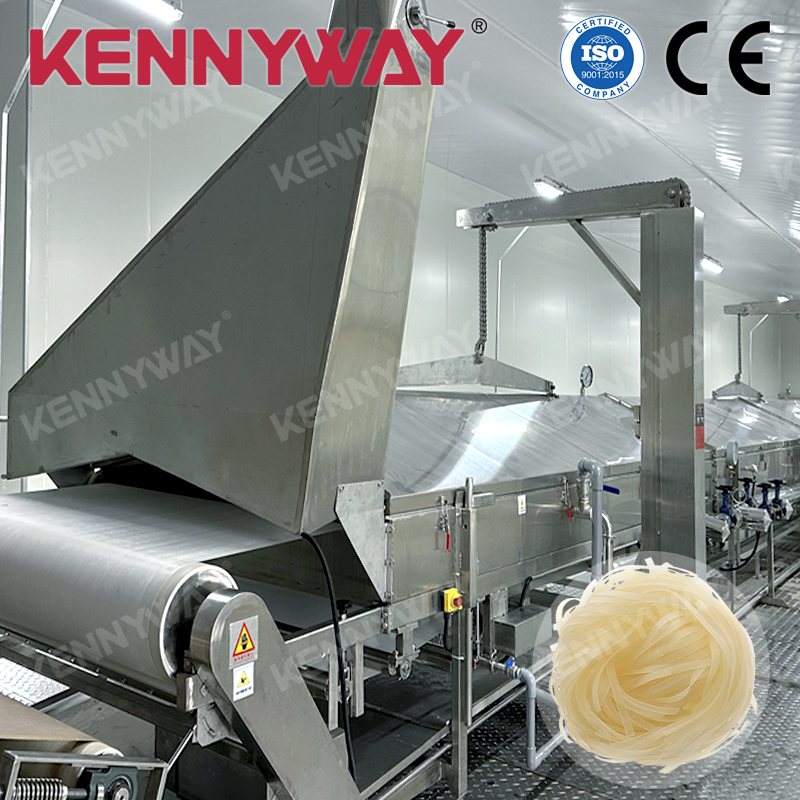
The cooking route transforms the liquid batter into a solid, elastic sheet. This requires multi-stage temperature control systems across a steaming tunnel that often exceeds 20 meters in length. The initial zones slowly raise the batter temperature to approximately 85°C to initiate gelatinization without causing surface blistering. Subsequent high-heat zones push the temperature to 100°C to ensure core cooking. The final zone drops slightly to 95°C to set the sheet. The length of the steaming tunnel must correspond exactly to the maximum belt speed to guarantee complete thermal penetration.
Before entering the steam tunnel, the batter must be distributed flawlessly across the conveyor belt. Mechanical leveling and spreading mechanisms, such as precision doctor blades or automated coating rollers, guarantee uniform sheet thickness. Even a single millimeter of variance across a 1000mm wide conveyor belt causes uneven cooking. Thinner sections will overcook, dry out, and disintegrate, while thicker sections remain raw and sticky in the center.
Removing moisture from the cooked noodle sheet requires precise thermodynamic control. Manufacturers must choose between different drying architectures based on facility space and product type. Integrating a Commercial Food Dryer involves balancing energy consumption with product handling requirements. The system must manage both dry bulb and wet bulb temperatures to control the relative humidity inside the drying chamber.
Drying System Type | Footprint Requirement | Product Handling | Drying Uniformity |
|---|---|---|---|
Multi-Pass Dryer | Compact (Vertical Stacking) | Multiple transfer points (turning) | High (exposes all sides to airflow) |
Single-Pass Dryer | Extensive (Long linear space) | Minimal (straight through) | Moderate (requires precise top/bottom airflow) |
Multi-pass systems stack conveyor tiers vertically, saving valuable floor space. As the noodles drop from one tier to the next, they flip, exposing all surfaces to the hot air for uniform drying. Single-pass systems require significant linear space but offer gentler handling for fragile formats. Regardless of the configuration, the system must balance energy consumption with precise moisture reduction. Aggressive, high-heat drying causes the surface of the noodle to harden too quickly, trapping internal moisture and causing structural cracking. Gradual, staged drying prevents these defects by allowing internal moisture to migrate to the surface at a controlled rate.
Adapting a standard line to produce instant formats requires significant structural modifications. An Instant Flat Rice Noodles Production Line must incorporate specialized portioning equipment. After the initial steaming and slitting, the continuous strands must be cut and shaped into individual blocks or nests, typically weighing between 60g and 80g. This shaping process prepares the product for final packaging and rapid consumer rehydration.
High-speed folding, cutting, and portioning automation handles delicate, partially dried noodle sheets without manual intervention. Mechanical cams and servo-driven rotary forming cups gather the strands, folding them into uniform weights and shapes. This equipment must operate synchronously with the main belt speed. Any timing misalignment causes product jams, resulting in massive line backups, wasted material, and severe mechanical strain on the drive motors.
Instant noodles require highly specific drying profiles to achieve shelf stability. Flash drying utilizes rapid moisture evaporation. High-velocity hot air, often exceeding 110°C, penetrates the noodle block, creating a porous internal structure. This porosity is exactly what allows the noodle to rehydrate quickly when the consumer adds boiling water. Engineering this rapid evaporation without degrading the texture or burning the flavor profile requires precise humidity and temperature sensors within the drying chamber.
Following the flash drying stage, the product retains significant residual heat. Integrating a cooling conveyor prior to the packaging stage is absolutely necessary. If hot noodle blocks enter sealed plastic flow wrappers, the trapped heat creates internal condensation. This moisture accumulation destroys the shelf stability of the instant product, leading to rapid microbial growth and mold formation. High-volume ambient air fans rapidly drop the product temperature below 30°C before sealing.
Continuous, automated lines require substantial linear space. A standard high-capacity line processing 1200 kg/hr can easily exceed 50 meters in length. Facility planners must calculate this footprint while factoring in mandatory sanitation zones, operator walkways, and raw material staging areas. Cramping the equipment against facility walls prevents maintenance teams from accessing critical drive motors, replacing worn bearings, or cleaning the steaming tunnels effectively.
Beyond physical space, the requisite utility infrastructure demands rigorous assessment. High-capacity lines consume massive amounts of energy and water. Facilities must provide industrial steam generation capable of maintaining constant pressure across the cooking route, often requiring boilers rated for 2 to 3 tons of steam per hour. High-voltage electrical loads (frequently exceeding 300kW) are required to power the grinder motors, dryer fans, and continuous conveyor drives. A continuous, high-volume water supply is mandatory for both the batter formulation and the automated cleaning cycles.
Regulatory compliance in food manufacturing relies heavily on equipment design. Manual cleaning of a 50-meter production line requires excessive labor hours and extends operational downtime. Evaluating the integration of automated Clean-in-Place (CIP) systems is critical. CIP systems utilize high-pressure spray balls installed directly inside the mixing tanks, steaming tunnels, and fluid piping. These systems circulate pre-rinse water, caustic wash, acid wash, and final sanitizing solutions automatically, ensuring repeatable, verifiable hygiene standards without requiring operators to dismantle heavy machinery.
Material selection directly impacts sanitation efficacy. Standard mild steel or low-grade alloys corrode quickly in high-moisture, high-salt environments. Production lines must utilize high-grade stainless steel. Comparing grades, 316L stainless steel offers superior corrosion resistance against salt and cleaning chemicals compared to standard 304 stainless steel. Furthermore, all structural joints and product contact surfaces must feature 100% hygienic, crevice-free TIG welding. Pitted welds or bolted joints create bacterial harborage points that CIP systems cannot effectively sanitize.
Complex and time-consuming changeovers represent a significant risk to overall equipment effectiveness. When a facility needs to switch between different noodle widths, formats, or recipe formulations, poorly designed equipment forces maintenance teams to spend hours unbolting cutters, replacing heavy rollers, and recalibrating sensors. This operational downtime destroys shift profitability and limits the manufacturer's ability to respond to changing market demands.
To mitigate this risk, prioritize an Automated Flat Rice Noodles Production Line engineered for rapid changeovers based on Single-Minute Exchange of Die (SMED) principles. Look for modular cutting rollers that slide out on rail systems. Quick-release conveyor belts allow sanitation teams to remove and clean belts without specialized tools. Centralized PLC recipe management enables operators to switch thermal profiles and belt speeds instantly with a single touchscreen command, rather than manually adjusting individual steam valves and motor drives.
Purge the batter lines and engage the automated CIP pre-rinse cycle.
Release the pneumatic tensioners on the slitting rollers.
Slide out the modular cutting cassette and insert the new width profile.
Select the new product recipe on the HMI touchscreen to automatically adjust belt speeds and steam zone temperatures.
Inconsistent moisture profiles pose a severe risk to product viability. If a batch exits the dryer with uneven moisture content, it leads to premature spoilage, microbial growth, or structural failure during transport. Packaged noodles that shatter during shipping result in rejected deliveries, costly chargebacks from retailers, and damaged brand reputation.
Implementing rigorous quality checks at each stage mitigates these risks. Install inline moisture sensors, such as Near-Infrared (NIR) technology, directly above the outfeed conveyor. These sensors scan the product continuously, feeding real-time data back to the dryer's PLC to adjust exhaust dampers automatically. If moisture levels drift out of specification, automated pneumatic rejection systems physically divert the non-compliant product off the line. Establishing strict QA checkpoints immediately following the steaming and drying stages ensures only perfectly calibrated noodles reach the packaging room.
To secure a reliable and high-yielding production environment, facility managers and engineering teams must execute the following steps:
Conduct a comprehensive facility audit to verify that existing steam generation, high-voltage electrical panels, and continuous water supply can support the peak loads of a continuous line.
Request documented sample runs from shortlisted manufacturers to physically validate starch gelatinization quality, sheet uniformity, and edge trim recycling efficiency.
Evaluate energy and water consumption metrics for the drying and steaming phases to accurately project daily operational utility expenses.
Plan preventative maintenance schedules around quick-release conveyor belts and modular cutting rollers to minimize future changeover downtime.
A: Entry-level commercial lines typically produce around 500 kg/hr. Industrial, high-capacity continuous lines are engineered to deliver highly stable daily outputs ranging from 900 kg/hr to 1200 kg/hr. The actual yield depends heavily on the active belt width, the length of the steaming tunnel, and the thermal capacity of the drying configuration.
A: Automation removes human error from batter formulation and thermal processing. Programmable logic controllers manage the steaming tunnel temperatures to ensure complete starch gelatinization. Automated dosing systems guarantee exact water-to-starch ratios. This continuous, regulated environment produces uniform thickness and superior elasticity across every single batch without manual intervention.
A: A wet milling grinder is optimal for flat rice noodle formulation. Soaking the rice before milling allows the grinder to produce an exceptionally smooth paste with a consistent particle size. This prevents grit from forming in the batter, ensuring the final noodle sheet maintains structural integrity without weak points.
A: Additives directly alter the rheological properties of the batter. Salt strengthens the starch network, improving elasticity and handling strength during the cutting phase. Specific modified starches enhance mouthfeel, prevent the sheets from sticking to the conveyor belts, and help stabilize the product's texture after final packaging.
A: Fresh noodles rely on strict sanitation, rapid cooling, and modified atmosphere packaging to prevent microbial growth. Instant noodles achieve a long shelf-life through flash drying. This process rapidly evaporates internal moisture to create a shelf-stable, low-water-activity product that resists spoilage at ambient temperatures.
A: Commercial dryers require massive utility support. They rely on high-capacity industrial steam generators or direct gas burners to maintain high-temperature airflow. High-voltage electrical infrastructure is also necessary to power the continuous drive motors, exhaust blowers, and high-velocity circulation fans distributed throughout the drying chambers.
A: Cleaning times depend entirely on the equipment design. Lines equipped with automated Clean-in-Place systems and quick-release belts can be fully sanitized in under two hours. Older, manual lines with bolted components and inaccessible crevices often require an entire eight-hour shift to clean thoroughly.