


close
Choose Your Site
Global
Social Media


Views: 0 Author: Site Editor Publish Time: 2026-10-14 Origin: Site


Food manufacturers face constant pressure to scale rice noodle output without degrading texture or structural integrity. Balancing high throughput with strict quality control is a daily operational challenge. Manual and semi-automated processes fall short here. They cause inconsistent gelatinization, drive up labor overhead, and increase contamination risks. Outdated methods simply generate excessive waste and bottleneck the supply chain.
To resolve these production hurdles, facilities must transition to a fully automated, purpose-built Rice Noodles Production Line. Modern equipment standardizes starch conversion and removes human error from the cooking equation. This guide breaks down the mechanical workflow of these systems. We compare specialized equipment configurations and provide a framework for evaluating machinery based on yield, facility constraints, and product type.
Process Precision: The core of any rice noodle operation relies on exact control over rice soaking, slurry milling, and starch gelatinization to dictate noodle chewiness and tensile strength.
Configuration Matters: Equipment requirements shift drastically depending on the end product—a fresh noodle line prioritizes rapid cooling and hygiene, while an instant line focuses on advanced drying and rehydration mechanics.
Risk Mitigation: Successful implementation demands modular machinery that can adapt to variances in raw rice quality and minimize downtime during product changeovers.
The manufacturing process begins with strict raw material intake protocols. You cannot produce high-quality noodles from substandard grain. Cleaning modules utilize specific gravity destoners and magnetic separators to remove stones, dust, and agricultural impurities from the raw rice. Selecting the right grain dictates the final texture. High-amylose Indica rice, typically containing over 22 percent amylose, works best. This high amylose content provides the necessary structural network that prevents the noodles from turning into mush during cooking.
Manufacturers generally choose between two primary batter preparation methods. Wet Milling involves soaking whole rice grains in temperature-controlled tanks for two to four hours. This achieves optimal internal moisture levels of around 30 to 35 percent before grinding. Stone or steel burr mills then crush the softened rice, creating a smooth, hydrated paste. Conversely, Dry Flour Hydration utilizes high-speed industrial mixers. You combine pre-milled rice flour directly with water. This modern approach saves valuable floor space and eliminates lengthy soaking times, though it requires highly precise water dosing systems to prevent dry pockets.
Preparation Method |
Equipment Required |
Processing Time |
Space Requirement |
Slurry Consistency |
|---|---|---|---|---|
Wet Milling |
Soaking tanks, burr mills, transfer pumps |
2 to 4 hours |
High |
Exceptionally smooth, natural hydration |
Dry Flour Hydration |
High-speed mixers, flour silos, dosing units |
15 to 30 minutes |
Low |
Requires precise mixing to avoid clumping |
Particle size distribution in the batter remains a critical quality metric. Operators measure slurry density using the Baumé scale to ensure consistency. A precise, uniform grind ensures a defect-free noodle matrix. If the particles are too large, the final product feels gritty. If they are too fine, the dough lacks the necessary tensile strength to survive the slitting process.
Starch gelatinization dictates the final product structure. Heat and moisture break down the crystalline structure of starch molecules in the rice batter. As the starch absorbs water and swells, it forms a cohesive, elastic gel. You must control this biochemical transformation perfectly.
The continuous steaming tunnel drives this process. The batter spreads onto a moving stainless steel mesh or Teflon-coated conveyor belt. It enters a sealed chamber filled with live steam. Steam pressure regulation, typically maintained between 0.3 and 0.5 MPa, and belt speed control are primary operational parameters. They dictate the thickness and the exact cooking degree of the noodle sheet. Operators balance the latent heat transfer to ensure the core of the sheet cooks fully without degrading the surface.
Advanced systems implement a Double Steaming Process. A secondary steaming phase occurs after the initial sheet formation. This ensures complete starch gelatinization. It significantly improves the elasticity of the strands and prevents breakage during packaging and transport.
Standard startup procedures for the steaming tunnel include:
Engage the exhaust fans to establish proper airflow through the chamber.
Open the main steam valves gradually to preheat the tunnel to 95°C.
Start the conveyor belt at a low speed to ensure proper tracking and tension.
Activate the slurry feed pumps and calibrate the spreader rollers for the desired sheet thickness.
Ramp up the belt speed to the target production rate while monitoring the gelatinization quality at the exit.
The steamed sheet must transition from a wide ribbon into individual strands. Rotary slitting mechanisms handle this task. Interlocking grooved rollers slice the dough sheet continuously. You can swap these rollers to change the noodle width, typically ranging from 1.5mm to 10mm. Cross-cutting guillotine technology then processes these flat noodles efficiently. Pneumatic cylinders drive the cutting blades to achieve precise length dimensions without tearing the delicate, freshly cooked dough.
Contrast this flat slitting method with vermicelli extrusion. Extrusion forces a thick dough through specialized metal die plates under high pressure. This creates thin, round profiles instead of flat ribbons. Extrusion requires a much stiffer dough consistency, usually around 40 percent moisture, and relies heavily on mechanical force rather than sheet spreading.
A multi-stage cooling process immediately follows the cutting phase. This halts the cooking reaction. Rapid temperature drops prevent the noodles from clumping together or becoming overly sticky. Industrial fans, air knives, and chilled water baths quickly dissipate the residual heat.
Non-fresh varieties require a dedicated drying phase. Humidity control and temperature gradients dictate the success of this stage. Slow, controlled moisture removal prevents the strands from cracking. If the exterior dries too quickly, it traps moisture inside. This leads to structural failure and mold growth later.
The production line integrates directly with automated weighing and packaging systems. Flow wrappers, cup sealers, or multi-head weighers prepare the product for distribution. Automated packaging ensures accurate portion control and maintains a hygienic barrier against environmental contaminants.
Success in this category depends entirely on high moisture retention. You need an extended shelf-life without relying on chemical preservatives. Rigorous hygiene is non-negotiable, as the high water activity makes the product highly susceptible to microbial growth.
A Fresh Rice Noodles Production Line relies heavily on ultra-clean cooling tunnels. UV sterilization lamps and HEPA air filters maintain a sterile environment. Modified atmosphere packaging (MAP) integration replaces oxygen with inert gases like nitrogen and carbon dioxide. This keeps the product safe and fresh for weeks under refrigeration.
Some manufacturers produce an instant fresh variant. These lines use advanced preservation techniques. Mild lactic acid washing or retort sterilization achieves ambient shelf stability without drying the noodles. This allows consumers to enjoy a fresh texture straight from the pantry.
Consumers demand rapid rehydration times for convenience meals. The noodles must soften quickly in boiling water while maintaining structural integrity. They cannot disintegrate into the broth.
An Instant Flat Rice Noodles Production Line utilizes specific steaming techniques to achieve this. High-velocity hot air impingement drying creates a highly porous noodle structure. The drying chambers blast 80°C to 100°C air directly onto the product. As the moisture evaporates rapidly, it leaves microscopic channels within the dough. This allows the strands to absorb hot water quickly during preparation while maintaining a satisfying, chewy bite.
High-volume output requires maximum mechanical efficiency. This specific method delivers a distinct, firm texture. It bypasses traditional steaming tunnels entirely, saving massive amounts of floor space.
A Friction-Cooked Instant Rice Noodles Production Line uses a pelletized extruding process. Single-screw or twin-screw extruders generate intense heat through mechanical friction and high pressure. Barrel temperatures can reach 110°C purely from shear force. This cooks the rice flour dough right within the extruder barrel before shaping. The sheer force aligns the starch molecules, resulting in a dense, resilient noodle that holds up exceptionally well in stir-fry applications.
The primary goal here is perfectly straight, uniform dry noodles. You must achieve zero breakage during transport and retail display. Curved or warped noodles fail quality control standards for premium packaging.
A Straight Rice Noodles Production Line features specialized hanging systems. The freshly cut noodles drape over stainless steel rods. Continuous rod-drying technology moves these racks through climate-controlled chambers on heavy-duty chains. This strict environmental control ensures slow, controlled moisture evaporation over 8 to 12 hours. Gravity pulls the noodles straight as they dry, preventing warping and maintaining a flawless profile.
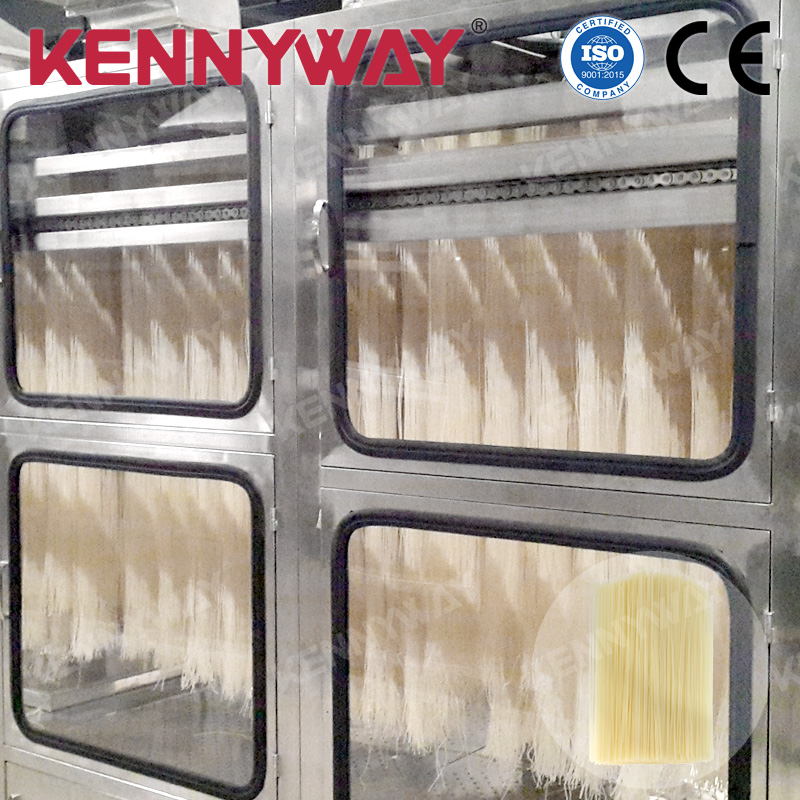
Calculating required floor space depends strictly on your target output in kilograms per hour. You must map the machinery dimensions against your available facility layout. Linear continuous lines offer incredibly high speed but demand a massive, uninterrupted footprint, often exceeding 50 meters in length. Multi-tier or U-shaped configurations save valuable space by stacking drying processes vertically or doubling back. However, they introduce more complex maintenance requirements due to tighter access points and additional transfer conveyors.
Configuration Type |
Typical Length Requirement |
Throughput Capacity |
Maintenance Access |
|---|---|---|---|
Linear Continuous |
40 to 60 meters |
1000+ kg/hr |
Excellent (Open sides) |
U-Shaped Layout |
20 to 30 meters (Wider) |
500 to 1000 kg/hr |
Moderate (Corners require attention) |
Multi-Tier Drying |
15 to 25 meters |
300 to 800 kg/hr |
Challenging (Vertical access needed) |
Semi-automated systems require manual transfer between the milling, steaming, and drying stages. Operators physically move carts of product. This introduces physical bottlenecks and increases contamination risks. Fully automated, PLC-controlled continuous lines eliminate these transfer points entirely.
Human-Machine Interfaces (HMI) and recipe memory functions streamline daily operations. Operators switch between product profiles with a single screen tap, adjusting belt speeds and temperatures instantly. Real-time IoT sensor data monitors temperature, humidity, and motor loads. This maintains consistent precision across the entire line. Automation drastically reduces labor overhead and minimizes human error during long production shifts.
Steam generation and drying chambers act as the primary energy sinks in any noodle factory. You must optimize these areas to remain competitive in a high-volume market. A standard 1000 kg/hr line requires approximately 1.5 tons of steam per hour.
Look for machinery equipped with advanced condensate recovery systems. Insulated steaming tunnels prevent thermal loss, reducing the load on your factory boilers. Implementing closed-loop water recycling for the soaking and cooling phases drastically reduces total resource consumption. Efficient steam traps and variable frequency drives (VFD) on large motors further optimize electrical usage.
Global food safety regulations demand strict sanitary design. Machinery must feature 304 or 316 stainless steel construction for all food-contact surfaces. Sloped drainage surfaces and the complete elimination of dead zones prevent bacterial growth and cross-contamination.
Automated Clean-in-Place (CIP) systems reduce sanitation turnaround times between production runs. Strategically placed spray balls flush the internal piping, soaking tanks, and extruder barrels with caustic washes and sanitizing solutions. This ensures strict, verifiable compliance with FDA, CE, or local food safety standards without requiring complete equipment disassembly.
Fluctuations in the amylose and amylopectin ratio of different rice harvests cause inconsistent noodle texture. A batch of rice from a different region or season behaves differently inside the steam tunnel. It may require more water or a longer steaming time.
Mitigate this risk by specifying equipment with adjustable milling tolerances. Variable-speed steaming drives and precise water-dosing mixers help operators compensate for raw material changes on the fly. Establishing strict intake testing protocols for your rice supply, including rapid amylose testing, minimizes unexpected production variables.
High wear and tear on extruder screws, slitter blades, and conveyor belts leads to unexpected production halts. Mechanical failures in a continuous line result in massive product waste.
Prioritize manufacturers offering modular machinery designs. Ensure they provide readily available standardized spare parts. Implementing predictive maintenance sensors, such as vibration monitors on main drive motors, allows your maintenance team to replace worn components before they fail catastrophically.
Implement a strict daily maintenance schedule:
Inspect and clean all rotary slitting blades to prevent dough buildup.
Check the tension and tracking of the main steaming conveyor belt.
Lubricate all high-temperature bearings on the drying chamber fans.
Verify the calibration of the inline moisture sensors.
Inspect steam traps for proper condensate discharge.
Inadequate cooling or drying leads directly to mold growth in packaged products. If the internal moisture of the noodle exceeds safe limits, the shelf life plummets.
Implement strict environmental controls within the packaging facility. Utilize inline moisture sensors immediately before the packaging stage to verify optimal hydration levels. Reject mechanisms can automatically discard product batches that fail to meet the required moisture specifications. Regularly calibrate your water activity (Aw) meters to ensure accurate readings.
Common Defect |
Probable Cause |
Corrective Action |
|---|---|---|
Brittle Noodles |
Over-drying or low amylose rice |
Adjust drying humidity; verify rice specifications |
Sticky Surface |
Incomplete gelatinization or poor cooling |
Increase steam pressure; lower cooling water temperature |
Uneven Thickness |
Improper spreader roller calibration |
Recalibrate roller gap; check slurry feed pump pressure |
Curved Strands |
Uneven airflow in drying chamber |
Adjust baffles in the drying zone; check fan VFDs |
Map your available factory floor space and utility connections to determine layout feasibility.
Define your exact product specifications and target hourly throughput to narrow down equipment categories.
Request technical spec sheets and layout drawings from shortlisted machinery manufacturers.
Schedule a pilot test using your specific raw materials to verify texture, yield, and operational efficiency.
A: A standard line typically requires a 1:2 ratio of raw rice to water. This accounts for soaking, milling, and automated CIP requirements. Implementing closed-loop water recycling systems can reduce overall consumption by up to 30 percent.
A: While front-end milling and steaming share similarities, back-end modules differ drastically. Fresh lines need ultra-clean cooling, whereas dried lines require extensive hot-air drying chambers. Hybrid lines are highly complex, less efficient, and generally not recommended.
A: Friction cooking uses mechanical heat generation within an extruder barrel to cook the dough. Traditional methods apply external steam to a flattened batter sheet. Friction systems offer a smaller footprint and produce a distinctly firmer noodle texture.
A: You should expect a realistic timeline ranging from three to six months. This period covers custom manufacturing, international shipping, factory acceptance testing (FAT), and final on-site commissioning.
A: Operators control thickness using adjustable spreader rollers and precise slurry feed rates. Modifying the conveyor belt speed inside the steaming tunnel also calibrates the final sheet thickness accurately.
A: Industrial systems require a stable three-phase power supply. Total kilowatt requirements vary heavily based on the specific drying technology utilized and the scale of the continuous steaming tunnel.


