


close
Choose Your Site
Global
Social Media


Views: 0 Author: Site Editor Publish Time: 2026-08-22 Origin: Site


The operational viability of any noodle manufacturing facility relies fundamentally on the precise alignment between raw material specifications and machinery capabilities. Procuring an instant rice noodle production line without a rigorous assessment of its raw material tolerances often results in processing bottlenecks, inconsistent product texture, high defect rates, and ultimately, a compromised return on capital expenditure (CAPEX). This technical guide evaluates the specific raw materials—from base grains to complex starches, oils, and additives—that modern production lines can process. It outlines how material selection dictates equipment configuration, quality control protocols, and overall production scalability. We examine the exact parameters required to maintain continuous, automated production, ensuring your facility avoids common mechanical failures like extruder clogging, uneven drying, or poor starch gelatinization.
Material Flexibility: Modern production lines can process a spectrum of bases beyond traditional rice, including corn, potato, bean, and mung bean starches, allowing for diverse product portfolios like starch vermicelli and hybrid noodles.
Amylose Content is Critical: The ratio of amylose to amylopectin in the chosen rice directly dictates the required gelatinization parameters and extruder configurations.
Equipment Customization: Processing specific materials (e.g., pure rice slurry vs. composite starch dough) requires distinct modular configurations, particularly in the milling, steaming, and drying stages.
Quality Assurance: Raw material consistency (moisture, ash, protein content, and oil purity) is the primary variable in preventing mechanical failures such as extruder clogging or uneven drying.
Identifying base materials that yield the required tensile strength is the first step in production planning. The chosen materials must deliver optimal rehydration speed and mouthfeel. They must also maintain smooth flow through the machinery without causing blockages or pressure spikes in the extrusion barrels.
High-amylose rice is strictly necessary for optimal elasticity and continuous processing. Factory operators typically select Indica varieties containing 22 to 28 percent amylose. This specific starch ratio provides excellent non-stick properties during high-temperature processing. The amylose forms a strong, stable gel network upon cooling through a process called retrogradation. This network gives the final noodle its characteristic chewiness, structural integrity, and resistance to dissolving in hot broth.
Low-amylose rice, such as Japonica, presents severe processing limitations on standard equipment. The higher amylopectin content creates a highly viscous, sticky dough. This gummy material frequently causes machinery fouling. It bridges in feed hoppers, causes auger slip inside the extruder barrel, and clogs die plates. The resulting end-products often clump together during the drying phase, leading to high rejection rates. Processing Japonica requires specialized Teflon coatings on contact parts and significantly modified hydration ratios.
Modern facilities often integrate corn, potato, bean, and mung bean starches into their formulations. This integration allows manufacturers to mass-produce variant products like starch vermicelli or glass noodles on the same base equipment. Mung bean starch provides exceptional transparency and tensile strength, though it comes at a higher raw material cost. Potato starch offers a softer bite, faster rehydration times, and excellent freeze-thaw stability.
Starch blending effectively reduces overall raw material costs while allowing operators to dial in specific product textures. However, blending modifies the gelatinization temperature of the dough matrix. Potato starch lowers the required cooking temperature, often gelatinizing around 60 to 65 degrees Celsius. Corn starch requires higher thermal input, closer to 75 degrees Celsius. Operators must make specific thermal adjustments in the steaming tunnel to accommodate these blended profiles. Failure to adjust steam pressure results in undercooked cores or entirely degraded, mushy starch networks.
Processing wheat flour on modified rice noodle lines requires specific technical adjustments. Highly refined wheat flour, such as maida, relies on gluten network formation for its structural integrity. Rice relies entirely on starch gelatinization. Processing wheat demands specialized kneading modules to develop this gluten network before the dough reaches the forming stage.
Manufacturers must establish strict protein content standards. Wheat flour must typically contain 10 to 12 percent protein for optimal noodle formation. The line must include resting conveyors to allow the gluten strands to relax for 20 to 30 minutes before sheeting or extrusion. Without these resting phases, the dough will shrink, warp, and tear during the cutting process, leading to inconsistent strand lengths and packaging failures.
Base Material Processing Characteristics and Machinery Requirements
Base Material |
Primary Component |
Processing Behavior |
Machinery Requirement |
|---|---|---|---|
Indica Rice |
High Amylose (22-28%) |
Firm gel, non-sticky, high elasticity. |
Standard high-pressure extrusion. |
Japonica Rice |
High Amylopectin |
Sticky, gummy, prone to clumping. |
Heavy anti-stick coating, modified augers. |
Potato Starch |
Large Starch Granules |
Low gelatinization temp, high transparency. |
Lower steam pressure in gelatinization tunnel. |
Wheat Flour |
Gluten Protein (10-12%) |
Requires mechanical kneading for elasticity. |
Dough resting conveyors and sheeting rollers. |
Mung Bean Starch |
High Amylose |
High tensile strength, glass-like finish. |
Extended high-temperature steaming zones. |
Secondary inputs interact directly with the primary base material to alter dough rheology. These interactions affect machine wear, processing speed, and ultimate shelf stability. Precise dosing of these ingredients is non-negotiable for automated production, as even minor variations can disrupt the entire line.
Water hardness directly impacts starch gelatinization and machinery lifespan. High levels of calcium and magnesium ions interfere with starch swelling, altering the required cooking time in the steam tunnel. Furthermore, hard water causes rapid scale buildup on boiler elements and steam injection nozzles, leading to uneven heat distribution and frequent maintenance shutdowns. Facilities should utilize reverse osmosis (RO) or industrial water softening systems to maintain water hardness below 50 ppm.
Hydration ratios vary drastically between milling methods. Dry milling processes require precise water dosing in high-speed mixers to achieve a crumbly, semi-dry dough. The moisture target is usually 30 to 35 percent. Wet milling processes create a liquid slurry. This requires a strict rice-to-water ratio, often around 1:1.5, to ensure the slurry flows evenly through the grinding stones and maintains the correct specific gravity for downstream pumping.
Salt modifies the starch matrix during the initial mixing phase. It tightens the dough structure, enhances flavor retention, and slightly inhibits enzymatic activity. This provides a more stable dough during unexpected processing delays, preventing premature fermentation on the factory floor.
Food-grade oils, such as refined palm oil, are used for coating or flash-frying. Coating prevents the noodle strands from sticking together in the packaging pouch, ensuring they separate easily when the consumer adds boiling water. Frying removes moisture rapidly to create a highly porous instant product. Continuous oil filtration systems are mandatory for frying lines. They remove carbonized starch particles, maintain oil purity, and keep free fatty acid (FFA) levels within acceptable limits to prevent rancidity in the final packaged product.
Food-grade additives improve dough cohesiveness and machineability. Guar gum, xanthan gum, and sodium alginate are common choices in industrial formulations. They prevent strand breakage during the aggressive cutting, folding, and portioning stages. These hydrocolloids bind excess free water, reducing stickiness on the transfer conveyor belts. They also improve the freeze-thaw stability of the noodles, which is critical for products destined for cold-chain logistics or long-distance export.
Extending shelf life for fresh or semi-dry instant noodles often requires pH modification. Lactic acid, citric acid, or malic acid is introduced in the mixing phase. Dropping the dough pH to around 4.2 to 4.5 effectively inhibits microbial growth and spore germination. However, acidic dough is highly corrosive to standard metals. All machinery contact parts, especially mixing blades, extruder screws, and die plates, must be constructed from 316L-grade stainless steel to withstand this continuous chemical exposure without pitting or rusting.
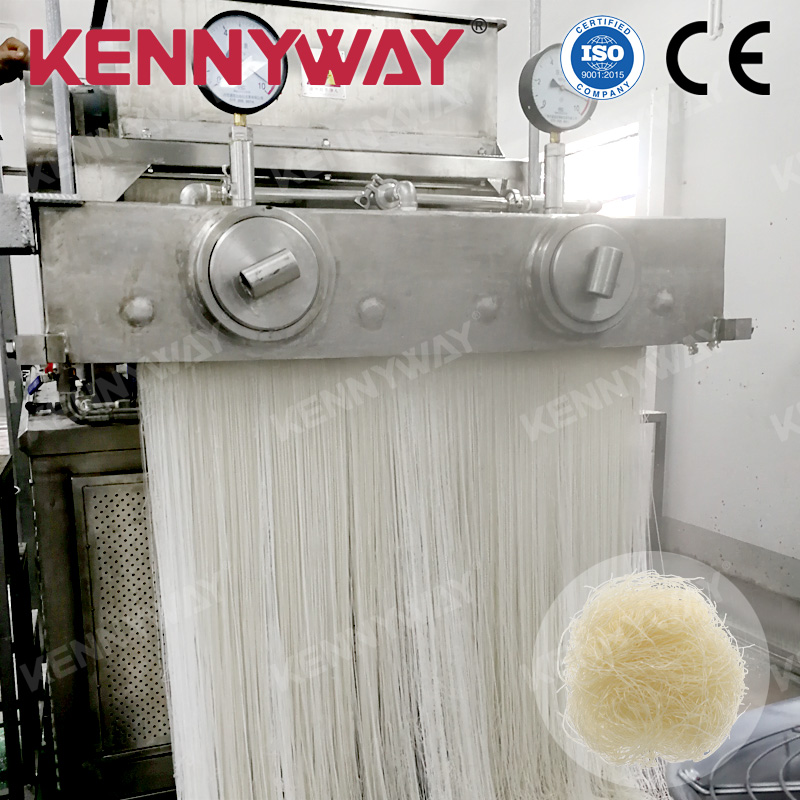
Raw material choices map directly to specific mechanical modules. You cannot run a liquid slurry through a dry powder extruder, nor can you sheet a crumbly dry dough without proper hydration. Equipment configuration must match the rheological properties of the chosen ingredients to maintain target throughput rates.
Dry powder mixing requires high-shear continuous mixers operating at high RPMs. These machines disperse water evenly into dry rice flour within seconds, preventing the formation of dry lumps or "fish eyes" that would later block the extruder die. Wet slurry preparation utilizes slow-agitation holding tanks. These tanks keep the suspended rice particles from settling at the bottom, ensuring a consistent solid-to-liquid ratio is fed to the steaming equipment.
Handling composite starch blends requires specific mixer designs. The varying particle sizes and bulk densities of corn, potato, and rice starches demand twin-shaft paddle mixers. These ensure a completely homogeneous blend before the material enters the extrusion phase. Poor mixing leads to localized weak spots in the noodle strands, causing them to snap during drying.
Material viscosity dictates the choice between single-screw and twin-screw extruders. Single-screw extruders handle standard high-amylose rice dough effectively. They generate the necessary pressure and shear to form the noodles through a specific length-to-diameter (L/D) ratio. Twin-screw extruders are required for complex starch blends or formulations with high fat content. They provide better mixing, precise temperature control across multiple barrel zones, and consistent forward pumping regardless of material slip.
The starch type determines the required steam pressure and duration in the gelatinization tunnel. Pure rice noodles may require 3 to 5 minutes of high-pressure steam at 100 to 105 degrees Celsius. Blends containing potato starch require lower temperatures, often around 90 degrees Celsius, to prevent the fragile starch granules from rupturing entirely and turning the noodle into an unworkable paste.
Processing flat rice noodles, such as Ho Fun, Pho, or Kuay Teow, requires entirely distinct machinery. A Flat Rice Noodle Line does not use high-pressure dough extrusion. Instead, it utilizes a precision liquid slurry spreading mechanism.
The machine pumps the highly refined, grit-free rice slurry onto a continuous stainless steel or Teflon-coated belt. The spreading mechanism calibrates the thickness of the liquid film down to the millimeter. The belt carries this thin liquid film through a long steaming tunnel, often 20 to 30 meters in length. The steam cooks the slurry into a solid, flexible, translucent sheet. Rotary slitter blades then cut this continuous sheet into flat strips of specific widths. This process demands rice flour milled to extremely fine specifications, typically passing through a 100-mesh screen, to ensure a smooth, uniform texture free of unhydrated specks.
Maintaining continuous, automated production requires strict raw material specifications. Variation in input quality immediately disrupts machine calibration, forcing operators to constantly adjust water feeds, steam valves, and belt speeds.
Facilities must develop a complete, documented list of ingredient standards. Every component must be verified for quality and traceability before entering the line. Base starches require certificates of analysis detailing exact amylose content and peak viscosity. Filtered oils require testing for free fatty acids and peroxide values. Rejecting out-of-spec materials at the receiving dock prevents costly downtime and massive product waste on the factory floor.
The acceptable moisture baseline for incoming rice and dry starches is strictly 12 to 14 percent. Moisture levels exceeding 14 percent promote microbial growth and mycotoxin development in storage silos. High moisture also throws off the automated hydration ratios in the mixing phase. If the flour is already too wet, adding the standard amount of water results in a dough that is too soft to extrude properly, causing it to pool at the die face. Climate-controlled storage with continuous humidity monitoring is highly recommended in tropical or humid geographic regions.
Strict mesh-size standards are required for all milled flours. Rice flour must typically meet an 80 to 100 mesh specification. Uniform granularity ensures even water absorption and consistent cooking in the steam tunnel. Coarse particles remain uncooked, creating hard white spots in the final noodle. These hard spots rapidly degrade the rotary cutting blades and create an unpleasant gritty texture for the consumer.
Ash content limits must be strictly enforced. Ash represents the inorganic mineral content, often originating from the rice bran layer or soil contamination. High ash content darkens the product, turning the noodles an unappealing gray color. It also introduces impurities that can weaken the starch matrix. Ash content should generally remain below 0.5 percent for premium instant noodle production.
Material-to-machine mismatches carry severe operational consequences. Identifying these risks early allows operators to implement effective mitigation strategies, protecting throughput and product yield.
Incomplete cooking is a primary risk in any starch-based production line. When the starch core fails to gelatinize fully, the resulting noodles exhibit a "white core" defect. They are brittle, snap easily during packaging, and exhibit poor rehydration when prepared by the consumer. This usually occurs when the steam tunnel temperature is too low for the specific starch blend, or the belt speed is too fast, denying the product sufficient residence time.
Mitigation requires implementing automated temperature sensors across multiple zones in the steaming tunnel. Operators must adjust feed rates based on the specific starch blend's thermal profile. Slower belt speeds allow more time for heat penetration when processing dense composite doughs or thicker noodle strands.
Uneven moisture evaporation causes micro-fractures in the noodle blocks. If the outside of the noodle dries too quickly, it shrinks around the wet core—a phenomenon known as case hardening. This thermal shock causes the noodle to shatter either on the cooling conveyor, inside the packaging wrapper, or during transport.
Mitigation involves calibrating multi-stage drying parameters using a psychrometric chart. Drying tunnels must have distinct temperature and humidity zones. Zone one should utilize high humidity and moderate heat to slowly warm the product and keep the surface pores open. Subsequent zones gradually decrease humidity and increase airflow to extract moisture safely from the core outward. These drying curves must be tailored specifically to the water-retention properties of the chosen raw materials.
An instant rice noodle production line offers substantial versatility, capable of processing various rice cultivars, composite starches, and hybrid wheat blends. However, this versatility is only realized when the machinery is correctly configured for the specific material's rheological properties. Ignoring raw material specifications guarantees operational failure, high defect rates, and damaged equipment. Buyers must select equipment manufacturers who offer modular designs, such as interchangeable extruders and adjustable steaming belts, and who can provide empirical testing data based on the buyer's specific raw material blend.
Follow these next steps to ensure a successful deployment:
Mandate a factory acceptance test (FAT) using your exact local raw materials to verify throughput, gelatinization efficiency, and final product quality before shipping the equipment.
Establish a strict incoming quality control checklist for moisture, ash, and amylose content before signing any bulk supplier contracts.
Train your machine operators on how to adjust steam pressure, extruder RPMs, and multi-stage drying curves when switching between different starch composites.
Implement a continuous oil filtration protocol and secure 316L stainless steel contact parts if your production process involves flash-frying or acidic pH adjusters.
A: Yes. While primarily designed for starch gelatinization, modified lines can process wheat flour. The equipment must feature appropriate dough kneading and resting modules to develop the gluten network. The wheat flour must meet specific protein content standards, typically between 10 and 12 percent, to ensure adequate elasticity and prevent tearing during sheeting.
A: High-amylose Indica rice is the optimal choice. It typically contains 22 to 28 percent amylose. This specific composition provides a firm, chewy texture and strong gel network. Crucially, it prevents the noodles from becoming overly sticky and fouling the machinery during the high-temperature extrusion and steaming processes.
A: Adding these starches alters the thermal requirements of the dough. Potato starch lowers the gelatinization temperature, while corn starch requires more heat. These blends increase elasticity and modify texture to produce starch vermicelli variants. Operators must adjust steaming times and multi-stage drying temperatures to process these composites successfully without degrading the starch.
A: A flat line requires a highly refined, low-ash liquid rice slurry. The rice flour must be milled to a very fine specification, usually 100 mesh, to eliminate grit. Because flat lines rely on thin-film spreading and continuous belt steaming rather than mechanical extrusion, the slurry's viscosity and hydration ratio must be perfectly consistent.
A: Breakage is usually caused by thermal shock and case hardening. This occurs when overly aggressive drying curves cause the outside of the noodle to dry and shrink faster than the wet core. Incorrect raw material hydration and insufficient gelatinization in the steaming tunnel also weaken the starch matrix, making the noodles highly susceptible to micro-fractures.
A: Significant changes in material viscosity and starch composition often require different mechanical setups. While a single-screw extruder works well for standard rice dough, complex starch blends or high-fat formulations may require a shift to twin-screw extrusion. Twin-screw systems maintain consistent pressure and throughput when handling materials with varying slip properties.


