


close
Choose Your Site
Global
Social Media


Views: 0 Author: Site Editor Publish Time: 2026-10-07 Origin: Site


Scaling flat rice noodle manufacturing requires balancing high-throughput automation with precise starch gelatinization. Plant managers face constant challenges maintaining authentic texture and tensile strength at scale. Poorly designed Flat Rice Noodles Production Lines cause inconsistent sheet thickness, excessive energy consumption during steaming, and severe product breakage that destroys yield rates. This guide provides facility engineers and technical buyers with a rigorous framework for evaluating industrial-scale machinery. We cover how to specify equipment configurations that integrate seamlessly from initial slurry preparation through to final packaging. You will learn the mechanical requirements for continuous belt steaming, the thermodynamics of starch gelatinization, and the specific module adaptations needed for fresh, dried, or instant formats. The goal is to ensure consistent product quality, maximize uptime, and optimize facility footprint.
Process Specificity: Unlike wheat noodles, flat rice noodles require precise slurry milling and continuous belt steaming to achieve proper starch gelatinization.
Format Adaptation: Equipment configurations vary significantly depending on whether the output is fresh, dried, or instant, directly impacting the drying, portioning, and packaging stages.
Customization is Critical: A customizable flat rice noodles production line allows manufacturers to adjust sheet thickness and cutting widths for specific regional products (e.g., Pad Thai vs. Ho Fun).
The foundation of any high-quality rice noodle lies in the initial slurry preparation. Industrial soaking tanks must accommodate high volumes of raw broken rice, maintaining controlled water temperatures to initiate hydration without premature fermentation. Facility operators typically target water temperatures between 25°C and 30°C, with soaking durations lasting anywhere from four to eight hours depending on the specific rice varietal. Soaking times dictate the softness of the grain, directly impacting the efficiency of the downstream milling process.
Continuous wet milling systems utilize precision-engineered corundum stones or stainless steel pin mills to grind the hydrated rice into a micro-fine suspension. The target particle size distribution usually falls between 80 and 100 mesh. If the particles are too large, the final noodle will exhibit a gritty texture and poor tensile strength.
Milling Technology |
Mechanism |
Particle Size Consistency |
Maintenance Requirements |
|---|---|---|---|
Corundum Stone Mills |
Friction grinding between two porous stones |
Excellent for ultra-fine traditional textures |
Requires regular stone resurfacing and dressing |
Stainless Steel Pin Mills |
High-speed impact shattering |
Good, but can produce slightly wider particle distribution |
Low maintenance, highly durable components |
Slurry viscosity and starch-to-water ratios act as the primary control parameters in this phase. If the slurry is too dilute, the resulting steamed sheet will lack structural integrity, causing severe tearing during the transfer phase. Conversely, excessive viscosity prevents uniform spreading across the steaming belt. Automated slurry feeding systems utilize mass flow meters and inline viscometers to continuously monitor and adjust the water dosage. High-shear agitation tanks operating at specific RPMs prevent starch granules from settling at the bottom of the holding vessels, ensuring a homogenous mixture reaches the spreader box.
Transforming liquid slurry into a continuous, solid sheet requires precise mechanical and thermodynamic control. The slurry is pumped into a spreader box that deposits a highly uniform layer onto a continuous conveyor belt. Fluid dynamics within the spreader box must be carefully managed to prevent turbulence, which causes uneven sheet thickness.
Facilities typically choose between two primary belt materials, each offering distinct operational characteristics:
Food-Grade Teflon Belts: Offer superior natural release properties, eliminating the need for surface oiling. They require careful tensioning to prevent stretching over time.
Polished Stainless Steel Belts: Provide exceptional durability and rapid heat transfer. They require automated food-grade oiling mechanisms to prevent the starchy sheet from sticking to the metal surface.
The steaming tunnel operates on strict thermodynamic principles. Engineers divide the tunnel into distinct temperature zones to manage the gelatinization profile. The initial zone rapidly raises the slurry temperature to approximately 90°C. The middle zone peaks near 100°C to force complete starch gelatinization. The final zone tapers down to 95°C to stabilize the matrix without overcooking. Overcooking leads to a mushy texture, while undercooking results in brittle, chalky noodles. Maintaining uniform sheet thickness across a belt that can span up to 1.5 meters in width requires precision-machined leveling blades and rigorous tension control on the conveyor tracking system.
Immediately exiting the steaming tunnel, the rice sheet possesses high moisture and extreme tackiness. Pre-cooling is an absolute requirement. High-velocity ambient air blowers and chilled water jackets positioned beneath the belt rapidly drop the sheet temperature to around 15°C. This thermal shock initiates starch retrogradation, significantly improving the tensile strength and eliminating surface stickiness before the sheet reaches the cutting blades.
Rotary cutting mechanisms slice the continuous sheet into precise widths. These slitter shafts feature hardened steel blades calibrated to micrometer tolerances to ensure clean cuts without fraying the noodle edges. Following the cutting phase, automated folding and portioning systems handle the delicate strands.
Automated folding arms gently overlap the strands into nested blocks designed for instant noodle cups or square pouches.
Straight-cut alignment conveyors stretch and cut the noodles into uniform lengths for traditional dried stick packaging.
Pneumatic diverters separate rejected portions based on optical sensor feedback, ensuring only uniform blocks proceed to dehydration.
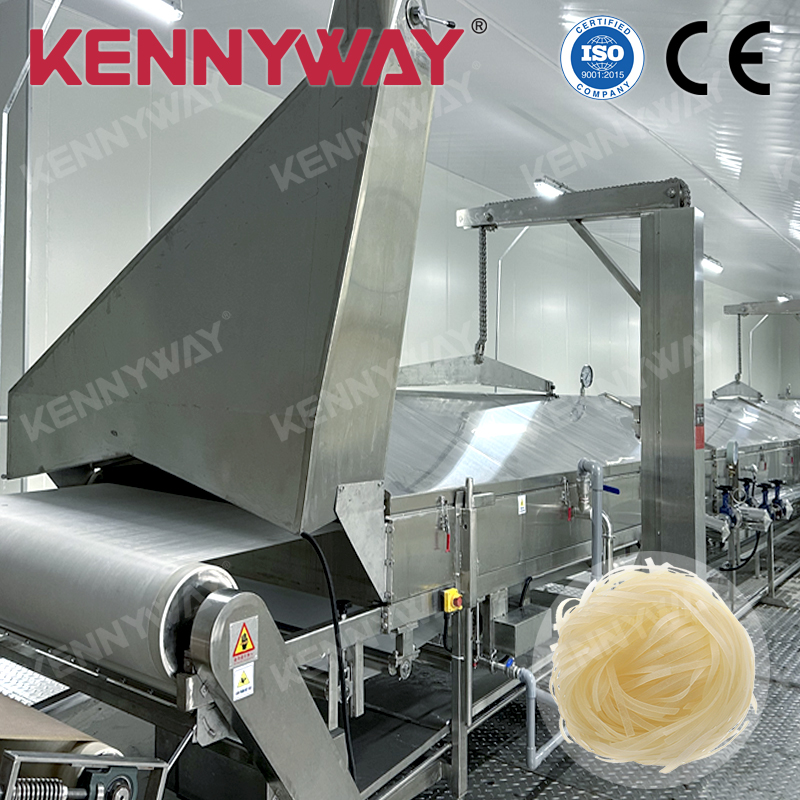
Operating a line dedicated to Fresh Flat Rice Noodle Production requires specialized handling to manage high moisture content, typically hovering between 60% and 65%. These lines bypass aggressive dehydration modules entirely. Instead, the focus shifts to minimal moisture loss, surface oiling to prevent clumping, and immediate hygienic packaging. Because fresh rice noodles possess an inherently short shelf life and are highly susceptible to microbial growth, the equipment must adhere to the highest sanitary design standards.
To extend commercial viability, facility engineers integrate inline pasteurization tunnels immediately following the primary packaging stage. These tunnels subject the sealed packages to temperatures around 85°C for 30 to 40 minutes. Alternatively, Modified Atmosphere Packaging (MAP) modules flush the sealed trays with a precise mixture of nitrogen and carbon dioxide. This displaces oxygen to inhibit mold and bacterial proliferation without altering the noodle's delicate texture.
The architecture of an Instant Flat Rice Noodles Production Line hinges on rapid, continuous dehydration. Once the noodles are cut and portioned into individual nests, they enter the drying phase. The chosen dehydration technology directly dictates the porosity, rehydration speed, and shelf stability of the final product.
Dehydration Technology |
Process Mechanics |
Product Characteristics |
|---|---|---|
Hot Air Impingement |
High-velocity hot air jets penetrate the noodle block |
Excellent rehydration times; highly porous internal structure |
Freeze-Drying (Lyophilization) |
Freezing followed by vacuum ice sublimation |
Premium texture preservation; exact cellular structure maintained |
Flash-Frying |
Brief submersion in high-temperature oil |
Rapid moisture removal; creates a highly porous, slightly oily matrix |
Handling brittle, fully dried noodles requires specialized transfer conveyors. Vacuum-assisted belts and soft-touch pneumatic grippers transfer the fragile blocks into automated packaging modules. Integrating flow wrappers or cup-sealing systems directly into the continuous line eliminates manual handling, drastically reducing mechanical breakage and product waste.
Manufacturing Flat Rice Noodles For Pad Thai demands specific structural characteristics. These noodles must withstand aggressive high-heat wok cooking, acidic sauces, and mechanical tossing without disintegrating. To achieve this, the production line must be calibrated to produce a slightly thicker sheet, typically between 1.2mm and 1.5mm.
The cutting rollers are spaced wider to achieve the traditional 3mm to 5mm strand width. More importantly, the drying profile is altered. Pad Thai noodles often undergo a controlled aging or retrogradation phase in high-humidity chambers kept at 4°C for up to 12 hours before final hot-air drying. This aging process crystallizes the starch molecules, locking in the dense, chewy texture required for stir-fry applications.
Selecting the appropriate level of automation depends entirely on projected throughput and SKU diversity. Fully automated continuous lines eliminate manual transfer points between steaming, cutting, and drying. They rely on centralized Programmable Logic Controllers (PLCs) from manufacturers like Siemens or Allen-Bradley to maintain strict recipe parameters. This results in exceptional product consistency and drastically reduced labor requirements. However, they require significant capital expenditure and longer changeover times.
Semi-automated batch systems offer higher flexibility for facilities running diverse, niche product lines. Operators manually transfer steamed sheets to resting racks or batch dryers. While this lowers initial equipment costs, it introduces variability in moisture content and increases the risk of contamination during manual handling. Facilities typically find that production volumes exceeding 500 kg/hr justify the transition to fully automated PLC integration.
Industrial noodle processing environments are inherently wet, hot, and humid, creating severe corrosion risks. All food-contact surfaces, including spreader boxes, conveyor meshes, and cutting blades, must be constructed from 304-grade stainless steel. Components exposed to high-salinity brines or aggressive cleaning chemicals should utilize 316-grade stainless steel to prevent pitting and rust.
Sanitary design extends beyond material selection. The steaming tunnel must feature accessible side panels or automated lifting hoods to allow operators to clean internal surfaces thoroughly. Eliminating dead zones where starch buildup can harbor bacteria is critical. High-end lines integrate automated Clean-in-Place (CIP) systems, utilizing strategically positioned 360-degree high-pressure spray balls to flush the slurry tanks, piping, and steaming chambers with caustic and sanitizing solutions without requiring equipment disassembly.
The physical layout of the production line heavily influences facility workflow and material handling efficiency. Engineers must match the equipment footprint to the available floor space while ensuring logical routing for raw materials and finished goods.
Layout Configuration |
Space Requirements |
Workflow Characteristics |
Best Suited For |
|---|---|---|---|
Linear (Straight-Line) |
Requires extensive length (often 30-50 meters). |
Simplest web handling; easy visual monitoring across all zones. |
Long, narrow facilities with dedicated raw material and packaging ends. |
U-Shaped |
Compact length; requires wider floor space. |
Brings packaging close to raw material intake; efficient labor utilization. |
Square facilities aiming to consolidate operator workstations. |
Multi-Tier (Vertical) |
Minimal floor footprint; requires high ceilings. |
Complex web handling; utilizes vertical space for drying passes. |
High-capacity instant noodle lines in space-constrained urban facilities. |
Workflow synchronization relies on advanced PLC systems to match variable frequency drive (VFD) conveyor speeds across mixing, steaming, drying, and packaging zones. If the drying conveyor runs marginally slower than the steaming belt, the noodle sheet will buckle and jam. Facility infrastructure must also support the line's utility demands. This includes high-capacity industrial steam boilers, robust floor drainage trenches to handle CIP wastewater, and heavy-duty HVAC systems to extract the massive ambient humidity generated by the steaming tunnel.
Procuring a Customizable Flat Rice Noodles Production Line provides operational agility. Forward-thinking plant managers specify modular equipment architectures. A modular steaming tunnel allows technicians to bolt on additional flange-mounted heating zones to increase throughput without replacing the entire machine. Similarly, modular drying cabinets can be expanded with extra passes to accommodate thicker noodle formats that require longer dehydration times.
Interchangeable cutting heads represent another critical customization feature. A well-designed slitter station utilizes quick-release mechanisms, allowing operators to swap rotary blade shafts in under twenty minutes. This capability enables a single production line to seamlessly transition from producing wide Ho Fun noodles to narrow Pho strands within the same shift.
Fragmented equipment sourcing often leads to integration failures. Purchasing the milling system, steaming line, and packaging wrappers from different vendors creates communication bottlenecks between disparate PLC protocols. Technical buyers must evaluate an OEM's capability to deliver end-to-end system integration using standardized communication protocols like EtherNet/IP or PROFINET. A unified control architecture allows the central HMI (Human-Machine Interface) to automatically adjust the slurry feed rate if the downstream packaging machine detects a temporary jam, preventing catastrophic product pile-ups.
Industrial steaming and hot air drying consume massive amounts of energy. Evaluating the thermal efficiency of the proposed line is paramount. Look for steaming tunnels insulated with high-density polyurethane or mineral wool to prevent heat loss. Advanced lines incorporate steam recovery systems that capture exhaust vapor and route it through heat exchangers to pre-heat incoming boiler water.
Component durability directly impacts equipment uptime. Teflon-coated belts, rotary cutting blades, and milling stones are high-wear items. Buyers must assess the OEM's use of standardized, globally available bearings and motors rather than proprietary components that require lengthy international shipping. A robust inventory of spare parts and accessible OEM technical support are critical factors in maintaining continuous operation.
Initial equipment commissioning rarely proceeds without friction. The most common bottleneck involves the rice sheet sticking to the conveyor belt or exhibiting uneven gelatinization. These issues usually stem from slight variations in the starch amylose content of the locally sourced rice compared to the rice used during the machine's design phase.
Mitigating this risk requires rigorous Factory Acceptance Testing (FAT). Buyers should ship their specific rice varietal to the OEM facility to conduct full-scale test runs before the equipment is crated. On-site, precise steam pressure tuning and micro-adjustments to the spreader box leveling blades are necessary to calibrate the machine to the specific rheology of the local slurry.
Advanced automation is useless if the facility operators cannot troubleshoot minor faults. Comprehensive OEM training programs must cover PLC alarm diagnostics, slurry viscosity calibration, and the mechanical synchronization of integrated modules. Operators must understand how altering the steam valve position impacts the final moisture content of the dried noodle.
Establishing a strict preventive maintenance schedule prevents unplanned downtime. Maintenance teams must execute the following routines:
Routinely inspect steam nozzles for scale buildup and clear blockages.
Verify the alignment of belt tensioners to prevent edge fraying on the conveyor.
Resurface milling stones to maintain the required slurry micron size.
Apply food-grade lubrication to all high-temperature bearings according to OEM specified intervals.
Calibrate inline viscometers and mass flow meters monthly to ensure slurry consistency.
Conduct a comprehensive utility audit to verify your facility's existing steam generation capacity, electrical load limits, and wastewater drainage infrastructure.
Require the equipment manufacturer to perform Factory Acceptance Testing using your exact proprietary rice blend to validate gelatinization profiles prior to shipment.
Specify modular equipment designs that feature interchangeable rotary cutting heads and expandable drying zones to future-proof your production capabilities.
Ensure all upstream milling and downstream packaging modules integrate into a single, unified PLC architecture to prevent communication faults.
A: Production capacities vary widely based on the equipment scale. Entry-level, semi-automated lines typically process around 200 kg/hr of finished product. Mid-range continuous lines handle 500 kg/hr to 800 kg/hr, while high-volume, fully automated industrial systems can exceed 1,000 kg/hr, depending on the noodle thickness and drying requirements.
A: An instant line incorporates aggressive, continuous dehydration modules—such as hot-air impingement dryers, freeze-dryers, or flash-fryers—to reduce moisture content below 10%. It also requires specialized handling and integrated packaging systems to manage the brittle, dried noodle blocks, whereas fresh lines focus on moisture retention and pasteurization.
A: Yes, provided the line is designed with modularity in mind. A customizable line utilizes adjustable slurry spreader boxes to alter sheet thickness and features interchangeable rotary slitter shafts, allowing operators to quickly switch between narrow Pho cuts and wider Pad Thai widths.
A: Continuous steaming tunnels demand substantial industrial utilities. Facilities require high-capacity steam boilers capable of maintaining consistent pressure, a high-volume potable water supply for continuous wet milling and belt cooling, and robust floor drainage systems to handle starchy wastewater and CIP chemical runoff.
A: Sticking is prevented through a combination of material selection and thermal control. Manufacturers use food-grade Teflon-coated belts for natural release or polished stainless steel belts paired with automated food-grade oiling mechanisms. Rapid pre-cooling of the sheet immediately after steaming also eliminates surface tackiness.
A: Procuring a custom industrial line is a capital project. Engineering, fabrication, and assembly typically require 3 to 6 months. Following delivery, installation, utility connection, and rigorous on-site commissioning usually take an additional 2 to 4 weeks before the line achieves commercial production stability.


