close
Choose Your Site
Global
Social Media

Views: 0 Author: Site Editor Publish Time: 2026-10-21 Origin: Site
Scaling traditional rice noodle manufacturing to meet global demand presents a serious operational challenge. Plant managers must balance high-throughput requirements with strict quality standards. You have to maintain precise moisture control, achieve exact starch gelatinization, and optimize energy efficiency simultaneously. A commercial Rice Vermicelli Production Line solves these problems through mechanical precision and continuous processing. Upgrading a facility or installing a new system requires significant capital. You must understand the exact mechanical workflow and technical specifications of modern equipment before making procurement decisions. This guide breaks down the continuous manufacturing process. We detail the mechanical stages from raw material handling to final extrusion and drying. You will learn how to evaluate equipment capabilities, manage production risks, and configure a system that meets your specific output requirements.
Process Precision: Consistent product quality relies heavily on the exact calibration of the mixing phase and the thermal dynamics within the extrusion machinery.
Automation vs. Flexibility: Fully automated lines reduce labor costs and contamination risks but require higher initial CapEx and strict raw material uniformity.
Critical Evaluation Metrics: Procurement decisions should prioritize Overall Equipment Effectiveness (OEE), sanitation compliance (CIP capabilities), and energy consumption per ton of output.
Risk Management: The most common point of failure in continuous production is improper starch retrogradation (aging), which can be mitigated through controlled environmental chambers.
A continuous manufacturing system requires a specific standard footprint. Plant layouts typically follow a linear or U-shaped modular design. This allows raw materials to enter one end and finished packaging to exit the other. Gravity-fed sections require adequate ceiling height, often exceeding six meters to accommodate silos and multi-tier drying racks. Modular architecture allows you to upgrade individual sections later. You can replace a cooling tunnel or add a secondary dryer without dismantling the entire Rice Noodles Production Line. Floor loading capacities must support heavy vibration from milling and extrusion equipment. Proper drainage channels are necessary for daily sanitation washdowns. Facility engineers must map out utility drops for steam, compressed air, and three-phase power before installation begins. Steam boilers must provide consistent pressure to the tunnel steamers, usually requiring a dedicated line separate from general facility heating. Compressed air systems power the pneumatic actuators on the cutting and folding mechanisms. These air lines require inline dryers and oil filters to prevent contamination of the food zone. Electrical panels must accommodate the high amperage draw of the extruder motors and the heating elements in the drying tunnels.
Automated material handling eliminates manual dumping and reduces airborne dust on the production floor. Stainless steel silos store raw rice or pre-milled rice flour. Pneumatic conveyors transport these materials to the mixing stations using positive pressure blowers. Rotary valves and loss-in-weight feeders provide precise dosing. These dosing units drop exact quantities of flour into the mixers based on programmed recipes. Automated handling ensures batch-to-batch consistency. It prevents foreign material contamination and keeps the processing floor clean. Sensors inside the silos monitor inventory levels and trigger alarms when raw materials run low. Dust collection systems integrate directly into the conveying lines to capture fugitive particulates, maintaining a safe breathing environment for operators.
Modern production relies on centralized control systems. Programmable Logic Controllers (PLCs) manage the mechanical sequencing of the entire line. Human-Machine Interface (HMI) panels give operators visual access to real-time data. You can monitor line speed, barrel temperatures, and ambient humidity from a single screen. Inline sensors feed data back to the PLC. If the dough moisture drops below the target threshold, the system automatically adjusts the water dosing valves. This closed-loop feedback prevents out-of-spec product from reaching the extruder. Advanced control infrastructure also logs historical data for quality assurance tracking. Variable Frequency Drives (VFDs) control motor speeds, allowing operators to fine-tune the throughput rate without stopping the machinery.
The process begins with proper hydration. Raw rice grains enter large soaking tanks. The mechanical soaking process allows water to penetrate the endosperm. Water temperature and soaking time dictate the equilibrium moisture content. Optimal hydration usually requires soaking at 25°C for several hours. This softens the grain and prepares it for the pulverizing stage. Proper hydration dynamics prevent excessive starch damage during grinding.
Following soaking, the rice moves to the milling stage. Wet milling uses stone or pin mills to grind the soaked rice into a fine slurry. Dry milling uses hammer mills to process unsoaked rice into dry flour. Wet milling generally produces a finer particle size distribution. This fine matrix improves dough hydration and results in a smoother noodle texture. Dry milling requires less floor space and consumes less water. The choice between wet and dry milling directly impacts the structural integrity of the final dough matrix.
Ingredient formulation requires precise ratios. Operators add water, salt, and secondary starches to the rice base. Tapioca or corn starch improves the chewiness and tensile strength of the noodle. Automated dosing systems inject these ingredients into the mixing chamber. The exact formulation dictates the cooking behavior of the final product.
Agitation mechanics play a critical role in moisture distribution. High-capacity mixers utilize elliptic biaxial blades. Two-speed mixing technology handles different phases of dough development. High-speed rotation disperses water evenly through the dry particles. Low-speed rotation gently folds the mixture. This prevents excessive shear and heat buildup.
The loose slurry must transition into cohesive dough masses. Automated kneading machines compress the hydrated flour. This forms small, uniform powder balls. Proper kneading prepares the mixture for the pressing stage. It prevents premature clumping and ensures the extruder receives a consistent feed rate. Inconsistent powder balls lead to surging inside the extruder barrel.
The Vermicelli Extruder serves as the heart of the operation. Mechanical hot pressing forces the dough masses through a rotating screw assembly. The screw conveys, compresses, and shears the dough. High pressure builds up just before the die plate. This pressure forces the dough through small orifices, shaping the continuous noodle strands.
To ensure a smooth production run, operators must follow strict startup procedures:
Preheat the extruder barrel zones to the specified recipe temperatures at least 30 minutes before introducing dough.
Verify that the die plate is securely fastened and that all extrusion orifices are completely clear of residual starch.
Engage the main drive motor at a low RPM to circulate the initial dough mass and build internal barrel pressure gradually.
Monitor the ammeter readings on the control panel to ensure the motor does not exceed its rated load capacity during the initial surge.
Gradually increase the feeder screw speed and main screw speed simultaneously until the target throughput rate is achieved.
Thermal and kinetic variables control the extrusion quality. Screw speed determines the residence time of the dough inside the barrel. Feeder screw speed controls the raw material intake rate. Barrel temperature zones apply specific heat profiles. Modifying these variables changes the density and texture of the extruded noodle. Too much heat causes the dough to expand rapidly upon exiting the die. Too little heat results in weak, brittle strands.
Starch gelatinization occurs under this combination of heat and pressure. The starch granules absorb water, swell, and rupture. This phase transition cooks the starch. It binds the matrix together and defines the noodle's tensile strength. Partial gelatinization allows the noodle to hold its shape during subsequent steaming. Full gelatinization makes the noodle ready for instant consumption.
Die plate versatility maximizes equipment utilization. Interchangeable extrusion dies allow one machine to produce multiple product formats. You can swap a fine mesh die for thin vermicelli with a larger die for thick rice spaghetti. Flat dies produce traditional Ho Fan noodles. Quick-change die mechanisms reduce downtime during product changeovers.
Extruded strands immediately enter a continuous tunnel steamer. Steam injection completes the cooking phase. It fully secures the starch network. The steaming time depends on the strand thickness. Proper steaming prevents the noodles from dissolving when boiled by the consumer. Exhaust hoods capture excess steam to maintain facility humidity levels.
After steaming, the noodles undergo a critical aging process known as retrogradation. The strands pass through cooling chambers. Temperature drops rapidly. The science behind retrogradation dictates the final bite of the noodle. When starch is gelatinized during extrusion and steaming, the amylose and amylopectin chains lose their crystalline structure and absorb water. If you dry the noodles immediately after steaming, these chains remain disorganized, resulting in a noodle that turns to mush when cooked. The cooling and aging chambers force the temperature down rapidly, usually holding the product between 4°C and 15°C for several hours. This specific thermal environment causes the amylose molecules to re-associate and form a new, stable crystalline lattice. This retrograded structure locks the moisture inside the matrix and provides the firm, elastic texture consumers expect. Facility managers must strictly control the humidity inside these aging chambers. If the air is too dry, the surface of the noodle will crack. If the air is too humid, condensation will form, promoting mold growth and ruining the batch.
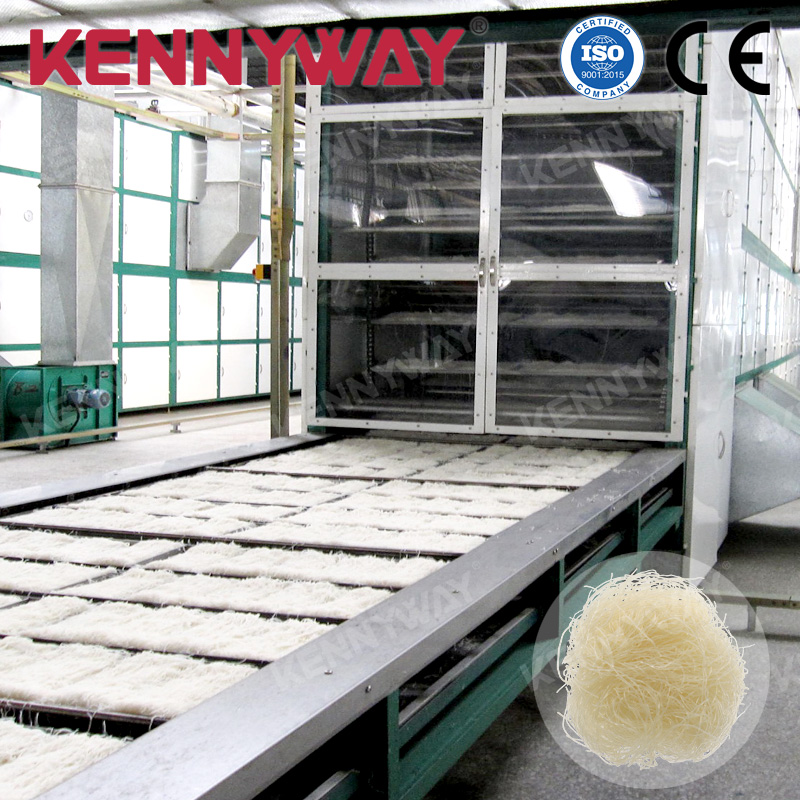
Moisture evaporation stabilizes the product for long-term storage. Multi-pass belt dryers use convective heat to slowly remove moisture. Heat pump drying systems use dehumidification technology. Heat pumps operate at lower temperatures, preserving the noodle's color and preventing surface cracking. Both systems aim to reduce the final moisture content to a shelf-stable 10-12%. Instant Rice Vermicelli Processing often requires specialized drying profiles to maintain a porous structure for quick rehydration.
Automated cutting mechanisms portion the continuous strands. Rotary cutters slice the dried noodles into uniform lengths. Folding mechanisms shape the strands into blocks or nests. Precision cutting ensures the portions fit perfectly into retail packaging. Sensors detect block weights and reject portions that fall outside the specified tolerance.
Calculating expected yield requires accurate facility mapping. A standard Rice Stick Production Line demands significant linear space. Continuous drying and aging tunnels often exceed 40 meters in length. You must calculate output in kilograms per hour against the available floor space. Multi-tier cooling and drying racks maximize vertical space. This reduces the overall footprint while maintaining high throughput. Ensure your ceiling height accommodates these multi-tier systems.
Scalability determines long-term viability. Evaluate the modularity of the equipment. Can you upgrade the extruder without replacing the entire drying tunnel? Modular designs allow you to increase capacity incrementally. You can add a second mixing station or extend the steaming tunnel as market demand grows.
Comparison of Processing Stages: Instant vs. Traditional Rice Sticks | ||
Processing Stage | Instant Rice Vermicelli | Traditional Rice Sticks |
|---|---|---|
Extrusion Pressure | High (creates porous structure) | Medium (dense structure) |
Gelatinization Level | Fully gelatinized during extrusion | Partially gelatinized, requires boiling |
Drying Method | High-velocity hot air / Heat pump | Low-temperature multi-pass belt |
Rehydration Time | 3-5 minutes in hot water | 10-15 minutes boiling required |
Facility Footprint | Compact drying sections | Extended aging and drying tunnels |
Sanitary design prevents microbial contamination. All food-contact surfaces must utilize 304 or 316-grade stainless steel. Crevice-free welding eliminates dead zones where dough can accumulate and spoil. Automated Clean-In-Place (CIP) systems flush the mixing tanks and fluid lines with caustic and sanitizing solutions. This reduces manual scrubbing and ensures repeatable sanitation.
Regulatory standards dictate market access. Equipment must meet CE or ISO compliance markers. FDA food contact surface regulations apply if exporting to North America. Verify that all gaskets, lubricants, and conveyor belts are food-grade certified. Non-compliant machinery will fail health inspections and halt production.
Machinery requirements differ based on the final product. An Instant Rice Vermicelli Production Line requires specialized freezing or high-heat drying steps. These steps create the porous internal structure necessary for quick rehydration. Traditional dry rice sticks require extended aging chambers and slower drying times. You must align your CapEx with your target market. Instant lines generally require higher upfront investment due to complex thermal controls.
Product versatility maximizes your return on investment. Assess the machinery's adaptability. Can the line produce diverse regional staples? Switching between Thai-style rice noodles and traditional thin vermicelli requires adjustable die plates and variable speed drives. High-end European or Japanese extrusion technology offers precise control and durability. Cost-effective alternatives exist, but you must evaluate their energy efficiency and expected maintenance intervals. Higher upfront CapEx often yields better energy consumption rates per ton of output.
Automation tiers directly affect operational costs. Manual lines require operators to transfer dough between mixing and extrusion stations. This increases labor costs and introduces human error. Semi-automated lines automate the continuous flow but require manual intervention for cutting and packaging. Fully automated lines handle everything from raw material dosing to final carton packing. Fully automated systems reduce batch-to-batch inconsistency. They lower error rates and minimize contamination risks. However, they demand strict raw material uniformity. Variations in flour moisture will trigger automated system faults.
Fluctuations in ambient humidity pose a severe risk. Changes in raw material quality also disrupt the process. These variables lead to brittle noodles that shatter during packaging. They can also cause sticky noodles that clump in the dryer. Inconsistent texture destroys brand reputation and increases product waste.
Implementing inline moisture sensors mitigates this risk. These sensors continuously scan the dough before extrusion. Automated feedback loops connect the sensors to the water dosing valves. If the dough is too dry, the system injects micro-doses of water. The system also adjusts extruder barrel temperatures dynamically to compensate for moisture variations. This keeps the gelatinization process stable.
Common Extrusion Defects and Troubleshooting Strategies | ||
Observed Defect | Probable Cause | Corrective Action |
|---|---|---|
Brittle or shattering noodles | Insufficient dough moisture or low barrel temperature | Increase water dosing rate by 1-2%; elevate zone 2 temperature. |
Sticky strands clumping together | Excessive moisture or incomplete gelatinization | Reduce hydration; increase residence time in the steamer. |
Uneven strand thickness | Partial blockage in the die plate orifices | Halt extrusion; remove and sanitize the die plate immediately. |
Surging or inconsistent output | Irregular powder ball formation during kneading | Adjust kneading machine compression settings; check mixer blades. |
Dark discoloration | Excessive shear heat burning the starch | Reduce main screw RPM; check cooling jacket water flow. |
Unplanned downtime destroys production schedules. Extruder screws experience severe mechanical wear from the abrasive rice dough. Die plates become blocked with hardened starch. Worn screws reduce extrusion pressure, altering the noodle's texture. Blocked dies cause back-pressure to build up, potentially damaging the gearbox.
Establish a strict predictive maintenance schedule. Track the run hours of the extruder screws and replace them before failure occurs. Maintain a strategic inventory of spare parts, including die plates, heating bands, and rotary seals. Train your operators on proper die-plate sanitation. Soaking dies in specific enzymatic solutions prevents starch hardening and extends component life.
Draft a comprehensive User Requirement Specification (URS) document detailing your throughput, footprint, and automation needs.
Evaluate potential vendors based on verifiable OEE data and their ability to provide local technical support.
Request pilot tests using your specific raw materials to validate the equipment's performance.
Consult with specialized food processing engineers to finalize your facility layout and utility requirements.
A: Commercial lines typically range from 200kg/hr for entry-level semi-automated systems to over 1000kg/hr for fully automated industrial setups. The exact capacity depends on the extruder size, drying tunnel length, and the specific type of noodle being produced.
A: Vermicelli extruders operate at higher temperatures and pressures to force starch gelatinization. Wheat pasta relies on gluten for structure, while rice dough lacks gluten. The vermicelli extruder must partially cook the rice starch during pressing to bind the noodle together.
A: The industry standard is 10-12% moisture content. This level ensures long-term shelf stability, prevents microbial growth, and keeps the noodles from becoming overly brittle during transport and handling.
A: While some modular lines offer adaptability, instant noodles require specific steaming, freezing, or high-heat drying steps to create a porous structure. Traditional lines use slow drying and aging. Switching between the two often requires bypassing or adding major equipment modules.
A: The base extrusion mechanics are similar, but glass noodles require mung bean or sweet potato starch, which behaves differently under pressure. Ho Fan requires specific flat-die configurations, altered steaming times, and different cutting mechanisms.
A: A fully automated continuous line requires significant linear space. Depending on the capacity, the entire footprint often exceeds 30 to 50 meters in length to accommodate the continuous steaming, aging, and multi-pass drying tunnels.
A: Retrogradation is the cooling and resting phase where gelatinized starch molecules realign and crystallize. This process gives the rice noodle its characteristic chewiness and prevents it from disintegrating or becoming mushy during final cooking.